Turning Trash into Tide-Breaking Design
What started as a simple question — “Can you build a boat entirely from rubbish?” — has evolved into a series of rigorous engineering challenges exploring how waste can take on a high-performance life at sea.
The SecondWave Mission: To sail a grassroots-built boat made from waste materials around the UK, delivering local events that inspire environmental awareness and STEM engagement through hands-on education.
Each project in this journey combines curiosity, environmental responsibility and hands-on naval architecture to show that innovation doesn’t always need to start with something new.
Volunteers from local communities near to the Solent will help build the boat to inspire STEM careers. To register your interest click here.
01 / The Pioneer: Redefining Household Waste
The Narrative:
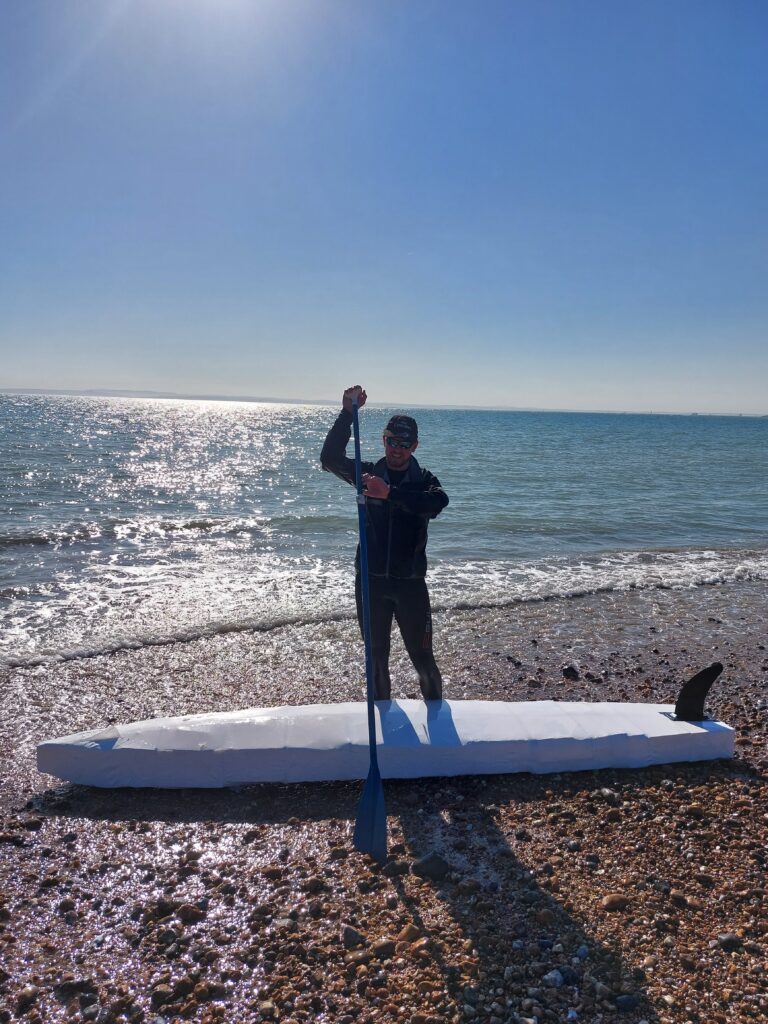
The first challenge was deceptively simple: build a functional paddleboard using only discarded materials found within a tight local radius. The backbone was formed from a discarded scaffold board, ribs from scrap plywood, buoyancy from leftover house insulation, and 100s of milk cartons.
The real engineering trial, however, was pulling it all together, particularly turning the hundreds of discarded plastic milk cartons from local coffee shops into a watertight cover. Working with recycled HDPE revealed just how stubborn plastic can be when heated, cooled, and reshaped with non-industrial tools; panels warped, thicknesses varied, and plans had to be constantly redrawn.
The Victory: Following simple engineering principles and a few structural calculations success prevailed. The finished board wasn’t just a prototype—it successfully circumnavigated both Hayling Island and the Isle of Wight.
🔧 Technical Spec Sheet
- Build Duration: 2 years (with a global pandemic)
- Core Materials: Scrap scaffold board, plywood, household insulation, and recycled HDPE (From 800 local milk cartons).
- Scavenge Radius: Sourced within a 20 mile radius of the workshop.
- Expedition Milestone: Completed full circumnavigation of the Isle of Wight.
02 / The Development: The Unsinkable Cross-Channel Kayak
The Narrative:
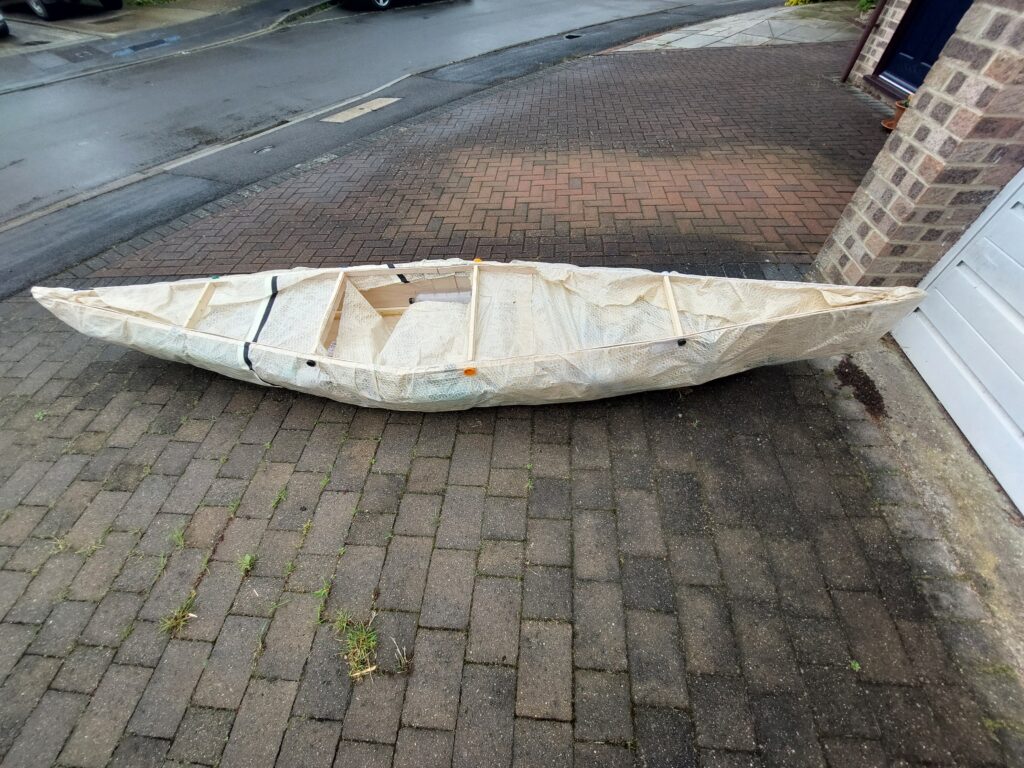
The second challenge took the lessons of the paddleboard and scaled them for open, unforgiving water. To tackle the English Channel, we engineered a kayak utilizing wooden panelling, lots of plastic bottles for buoyancy, and a discarded sail sourced from a boat that had sailed around the world.
The build was a race against the clock, completed in just 3 weeks. This speed meant navigating several unexpected design hurdles, culminating in a grueling launch from a punishing stone beach. Yet, the core engineering principle held true: the deliberate, high-buoyancy bottle-composite design meant she physically could not sink. Despite rough waters and design constraints, the vessel crossed the English Channel successfully.
The Victory: Despite a tight timescale, combining simplicity and age tested techniques, the kayak could compromise on robust-ness through multiple contingencies and risk reduction.
🔧 Technical Spec Sheet
- Build Duration: Just 3 weeks from concept to launch.
- Core Materials: Plywood, hundreds of plastic bottles, repurposed sail cloth.
- The Challenge: Extreme launch conditions off a stone beach.
- Scavenge Radius: Sourced from 10 mile radius from the workshop
- Expedition Milestone: Completed full English Channel crossing.
03 / SecondWave: The UK Circumnavigation Trimaran
The Narrative:
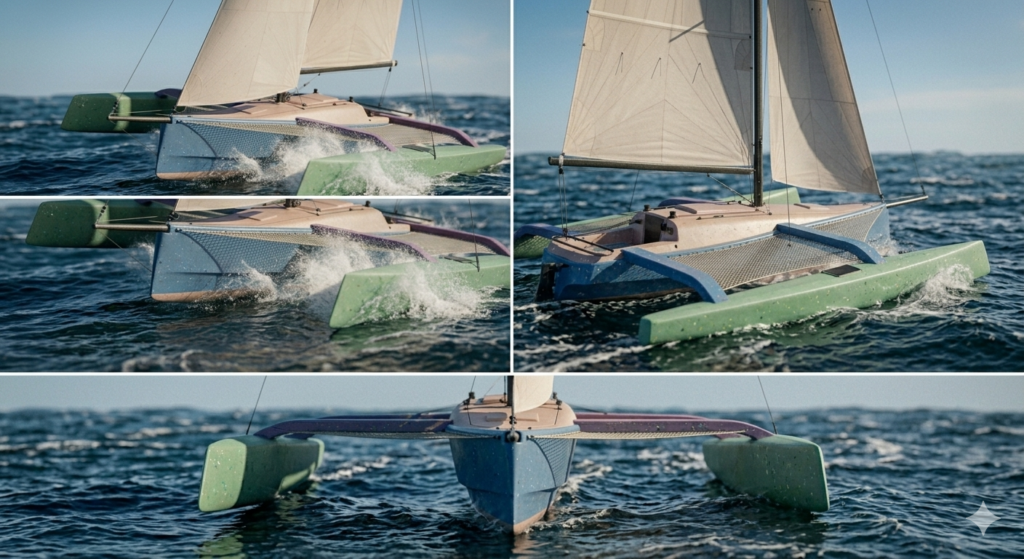
Now, the next chapter begins. We are scaling our proven concepts into something bigger, faster and more exciting – a trash trimaran. Built using repurposed boat parts recovered from the Solent and sustainable scrap materials sourced from across the UK, this vessel is designed to push the boundaries of circular naval architecture.
Our goal is audacious: to sail entirely around the UK, stopping daily to run educational STEM workshops and engage local coastal communities.
The Engineering Breakdown: Why a Trimaran?
⚡ Speed
By eliminating the need for a heavy, traditional lead ballast, the multi-hull design remains incredibly lightweight, agile, and easily driven by the wind.
⚖️ Stability
The wide-set outer hulls provide an inherently high righting-moment, ensuring exceptional stability in unpredictable UK coastal waters.
🏗️ Structure
A substantial central hull offers the essential “real estate” needed to stiffen and strengthen the vessel, using a repurposed wind turbine blade for immense longitudinal strength.
The design:
The design draws aspects from pedigree performance multi-hulls and balances it with the inherent challenges of working with waste materials. Currently, the goal is to utilise the following:
- Derelict boats: These will ideally provide the hardware to control the trimaran, panels and strength.
- Plastic: While PLA can be recycled this is normally challenging and usually ends in land-fill. This can be used to design a light-weight exact form with 3D printing on a large scale.
- Turbines: The goal would be to repurposed wind turbine blade as it provides unmatched stiffness against bending forces. However, other waste composite such as masts could still increase vessel stiffness without much weight.
- Bottles: As is the theme with the other projects, there will always be some sort of bottle involved!
SecondWave represents the convergence of STEM education, engagement, environment and expedition – the four pillars at the heart of this ongoing journey.
Looking Ahead
The project’s mission is simple:
To show that engineering is for everyone – and that environmental action can be practical, creative and even adventurous.
Through collaborations with local schools, community groups and partners, SecondWave aims to spark curiosity promote circular thinking and inspire the next generation of engineers and problem-solvers.
Because sometimes, the best way to chart a sustainable course is to take what’s already out there – and set sail again.
